
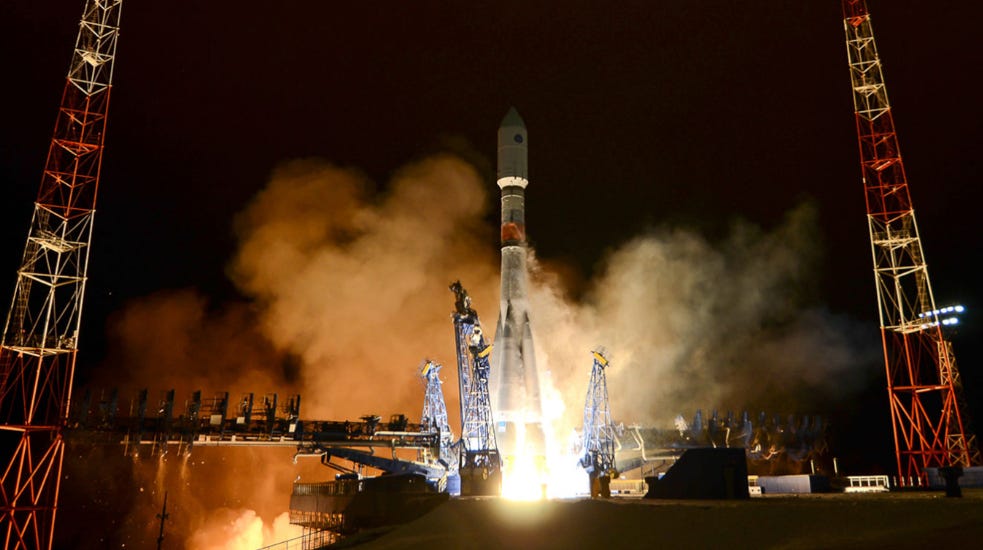
*Image above: Russian military satellite taking off from Plesetsk cosmodrome (Source: Roscosmos)
Russia is urgently attempting to close its strategic communication gap through the Rassvet satellite program after losing access to Starlink. Since Russia’s domestic satellite capabilities following the 2022 invasion of Ukraine proved to be woefully inadequate, Russian military forces were forced to rely on captured or smuggled Starlink terminals. However, after SpaceX deactivated these illicit connections in early 2026, Moscow had to fill the gap by pivoting toward a rapid-deployment solution: a “Starlink-like” constellation developed in apparent cooperation with China’s Shanghai Spacecom Satellite Technology (SSST).
While this partnership enables Russia to bypass the immense costs and risks of domestic manufacturing, it facilitates a creeping “Sinicization” of Russia’s military space sector. By adopting Chinese hardware designs, such as the flat-panel Rassvet Gen1 satellites, Moscow appears to have gained a potential battlefield equivalent to Starlink but risks a precarious, long-term dependency on Beijing in exchange for its access to this technology. Russia is trading its last remnants of strategic autonomy in space for a survival-driven military capability that appears to be strongly influenced by an influx of Chinese technology for its ailing satellite communications program.
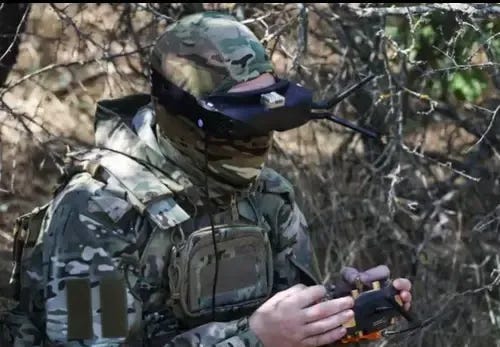
Picture above: Russian soldier using satellite comms image: Source ITAR-TASS
Moscow’s Wartime Gap in Tactical Space Communications
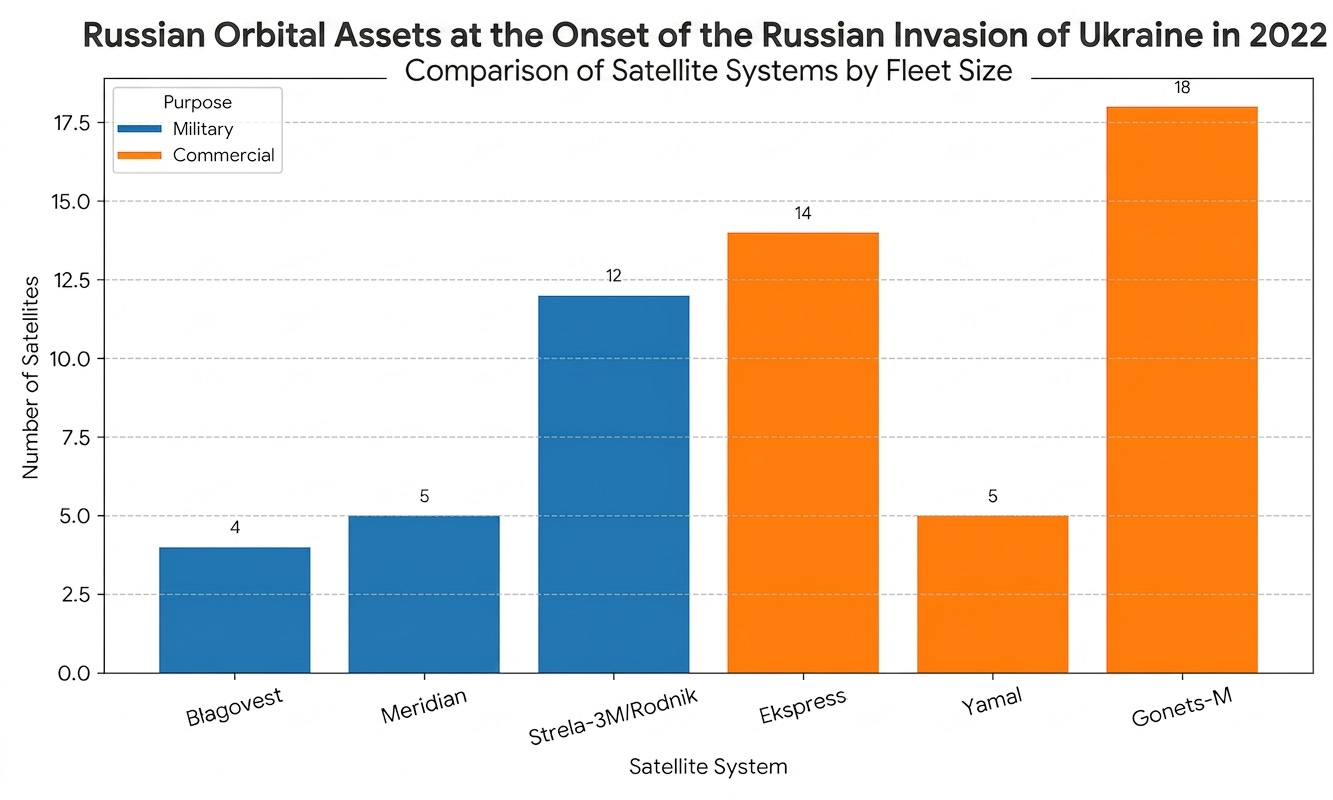
When Russia launched its full-scale invasion of Ukraine in 2022, its space-based inventory for conducting the war was ill-equipped for the demands of modern, high-intensity warfare. Moscow’s primary military communication systems, Blagovest and Meridian, lacked the capacity and satellite density required to support Russian forces deployed across a 1,000-kilometer (630 miles) frontline. While the low-orbit Strela-3M/Rodnik system was partially operational, its low satellite count meant it could only play a limited support role alongside its commercial counterpart, the Gonets-M.
Russia’s Ekspress fleet of commercial satellites also was unavailable to the military as its capacity was entirely booked by its corporate clients. This left the Yamal satellites—belonging to the state-owned energy giant Gazprom—to try and fill the remaining gaps, but they could only partially satisfy the military’s communication requirements. This systemic shortfall, compounded by a shortage of mobile satellite ground terminals, many of which were old and bulky, eventually forced Russian personnel into the precarious position of relying on captured or smuggled Starlink hardware for battlefield connectivity.
The following table details the status of Russia’s orbital assets at the onset of the Russian war with Ukraine:
Due to these shortcomings in its wartime space communications, Russian military personnel were forced to switch to using Starlink on the battlefield as early as the fall of 2022, which began after they started utilizing captured Ukrainian terminals. Given their importance to Russian military operations, Moscow sought to fill its battlefield communication requirements by developing a massive clandestine smuggling supply network overseas. These purchases enabled Moscow to make significant clandestine acquisitions of the Starlink terminals abroad, most of which were acquired in Europe, Turkey, the United Arab Emirates, and a few other countries. As a result of this effort, Starlink terminals increasingly appeared in the occupied territories of Ukraine. In fact, the number of terminals acquired by Moscow was so successful that Russian forces began mounting Starlink terminals on expendable Shahed-type drones used in strikes against Ukrainian cities and electrical power plants.
By February 2026, SpaceX had finally switched off all the terminals illegally acquired by Russian forces, causing a temporary – but major - collapse of Russian military communication systems in Ukraine. To make matters worse for Moscow, its own military communication services still had not registered any improvement in filling the gap in tactical military communications problem since 2022. Regardless, it continued to search for an acceptable solution to its problem by investing in the development of a system capable of replacing Starlink from 2022 to 2025.
It was during this period that Russia began investing more intensely in the development of small communication satellites for low Earth orbit. This effort initially began as early as the late 2010s when SpaceX and OneWeb started to deploy their satellite constellations. The dominant idea behind Russian thinking for this effort was to develop a satellite system for the Internet of Things and to obtain more money for its space industry from the domestic, as well as the global market. Through these efforts, Russia was attempting to keep its place among the world’s leading space powers.
By 2026, Russian ambitions for the global space market had been mostly abandoned as Moscow turned its efforts to developing wideband satellite communications for combat operations needed to operate different types of drones, particularly long-range Unmanned Aerial Vehicles (UAVs), as well as those to assist in military command and control. By October 2025 there had been an even higher upsurge in demand for these systems on the battlefield, according to ITAR-TASS. Russian universities and UAV manufacturers experimented with the control of unmanned aerial vehicles via satellites in low-Earth orbit (1,400 kilometers) and in geostationary orbit (approximately 36,000 kilometers).
Moscow’s Pivot to the Rassvet Network
On March 23, 2026, a batch of 16 small wideband communication satellites, Rassvet (Dawn in Russian) were launched into orbit from the Russian military space launch site Plesetsk. By mid-April 2026, these satellites were still in an early phase of deployment because they needed to move from the 300-kilometer (km) orbit of placement to an 800-km operational orbit using onboard electric thrusters. The developer and manufacturer of the satellites is a Russian private space company known as Bureau 1440, which belongs to X-Holding, and is focused on Internet surveillance and lock-up hardware and software, and affiliated with the leadership of the Russian Federal Security Services (FSB). Bureau 1440 itself was established in November 2020.
The entire Rassvet constellation will eventually consist of between 292 to 318 satellites by the end of 2028. The satellite system could cost more than 430 billion rubles ($5 billion), including about 103 billion rubles ($1.2 billion) from the federal budget and 329 billion rubles (about $3.9 billion) of the company’s own investments. This means the average cost of one Rassvet satellite, including the cost of launch services, would cost $15.7 million per each micro-satellite, or be approximately 15 times higher than the production and orbiting cost of one Starlink satellite. Moreover, the planned cost of the fully deployed and operational system is comparable to the originally planned cost of the GLONASS program for 2021–2030, 484 billion rubles or $6.7 billion. Even though the cost of the Rassvet program includes the research and development phase, it still appears extremely high.
Bureau 1440
Besides the outrageous cost of the system, another prominent aspect involved here is the specifications of the Rassvet satellites and the role of Bureau 1440. Bureau 1440 is a Russian private aerospace company that is part of ICS Holding, developing a low-Earth orbit (LEO) satellite constellation to provide high-speed, low-latency broadband internet designed to compete with Starlink.
Bureau 1440 launched its first three test satellites as part of the Rassvet-1 mission in June 2023. These satellites had a mass of 80 kilograms (kg). This was followed by the Rassvet-2 mission, which began in May 2024, and there were three completely new satellites with a mass of 120 kg. The second mission was focusing on testing broadband communication equipment and the laser communication system between satellites. Twenty-two months later, Bureau 1440 orbited another generation of Rassvet satellites: Rassvet Gen1. These satellites have little in common with the Rassvet-1 and Rassvet-2 satellite missions, and although they are newer satellites, they are also significantly heavier, weighing up to 370 kilograms, and feature 6-beam active phased array antennas that provide a communication speed of 1 gigabit per second. Simply speaking, the Rassvet R&D phase spanned five years and included two technology demonstration missions, each deploying as many as three satellites. Consequently, the production-series Rassvet Gen1 satellites differ significantly from the experimental models trialed between 2023 and 2024.
On the one hand, Bureau 1440 publicly declares that it has approximately 3,000 employees, and 80% of these personnel are engineers. However, on the other hand more than half of its employees seem to have never been associated with the space industry before, and possibly could be nothing more than software engineers. Its manufacturing facility is located somewhere in or near Krasnogorsk. Located on the outskirts of the Moscow metropolitan area, this is not a likely place to build satellites. The company also cooperates with Bauman Technical University (including the use of the university’s test laboratory) and the Moscow Aviation Institute, and this cooperation is especially related to satellite onboard electrical propulsion systems.
However, these examples outlined above are the only known cooperative ties between Bureau 1440 and other Russian scientific entities or suppliers of satellite components. Therefore, Bureau 1440 pretends to produce hundreds of small but advanced low-orbit communication satellites from scratch, mostly by itself, using unknown manufacturing facilities, and inevitably faces a shortage of qualified workforce personnel because of labor shortages inside Russia caused by the negative demographic trend, decline of the education system, and the ongoing war against Ukraine, now in its fifth year.
The Sinicization of Rassvet
The only plausible explanation for the unusually rapid high-speed development of the Rassvet Gen1 satellite and the sudden transition from its predecessor, Rassvet-1, is Russian cooperation with China. For example, the Rassvet Gen1’s flat-panel architecture closely mirrors SpaceX’s Starlink (v0.9, v1.0, and v1.5), which was deployed between 2019 and 2023. Similarly, China’s Qianfan low-orbit communication satellites, which began deployment in August 2024—eighteen months before Rassvet Gen1—also share significant design similarities with earlier Starlink generations. Qianfan was developed by Shanghai Spacecom Satellite Technology (SSST) in the early 2020s and is quite similar to the first generations of Starlink satellites, as well as the Rassvet Gen1 satellites. Moreover, the Qianfan satellite constellation became operational one and a half years before the Rassvet Gen1.
Consequently, Rassvet Gen1 is likely the result of close cooperation between Bureau 1440 and SSST. Under this assumption, Bureau 1440 would primarily focus on adapting Chinese satellite hardware to meet Russian specifications, as well as developing proprietary software for the space-based platform.
Through this approach, the Russian company bypasses the immense complexity and cost of building its own domestic manufacturing facilities and supply chains. In addition, Russian officials can avoid incurring most of the development risks because SSST took the risks on its own.
Outlook
Going forward, the only major considerations for the Russian side are money for the purchase of the satellites and developing the necessary hardware and software upgrades to operate the new Russian space-based constellation network using Chinese tech. In short, the Kremlin appears to be leveraging Chinese manufacturing capabilities and risk-taking to bypass its own domestic supply chain needs. However, it is doing so at the expense of its own long-term strategic autonomy in space. Ultimately, if the entire supply chain of Rassvet Gen1 satellites were delivered from China, Russia could lose the last remnants of its strategic autonomy in space affairs.
In the final analysis, Moscow’s strategy to offset the loss of illicit Starlink access just to maintain parity with Ukraine on the battlefield runs the risk of a ‘Sinicization’ of its military space sector. This creates a precarious dependency that not only threatens to compromise the independence of Russia’s military space activities but could ultimately become irreversible.
Thank you for your support! Please remember that The Saratoga Foundation is a non-profit 501(c)(3) organization. Your donations are fully tax-deductible. If you seek to support The Saratoga Foundation, you can make a one-time donation by clicking on the PayPal link below! You can also subscribe to our website to support our work.
https://www.paypal.com/donate/?hosted_button_id=XFCZDX6YVTVKA
As russia bleeds in ukraine, they may be fighting the wrong war. Siberia is melting as agrarian land starved china is ready to reassert territory lost to russia and sinicize siberia; reports are they are already infilrating siberia. The depleted russian military vs PLA? i would bet on the chinese winning that.