
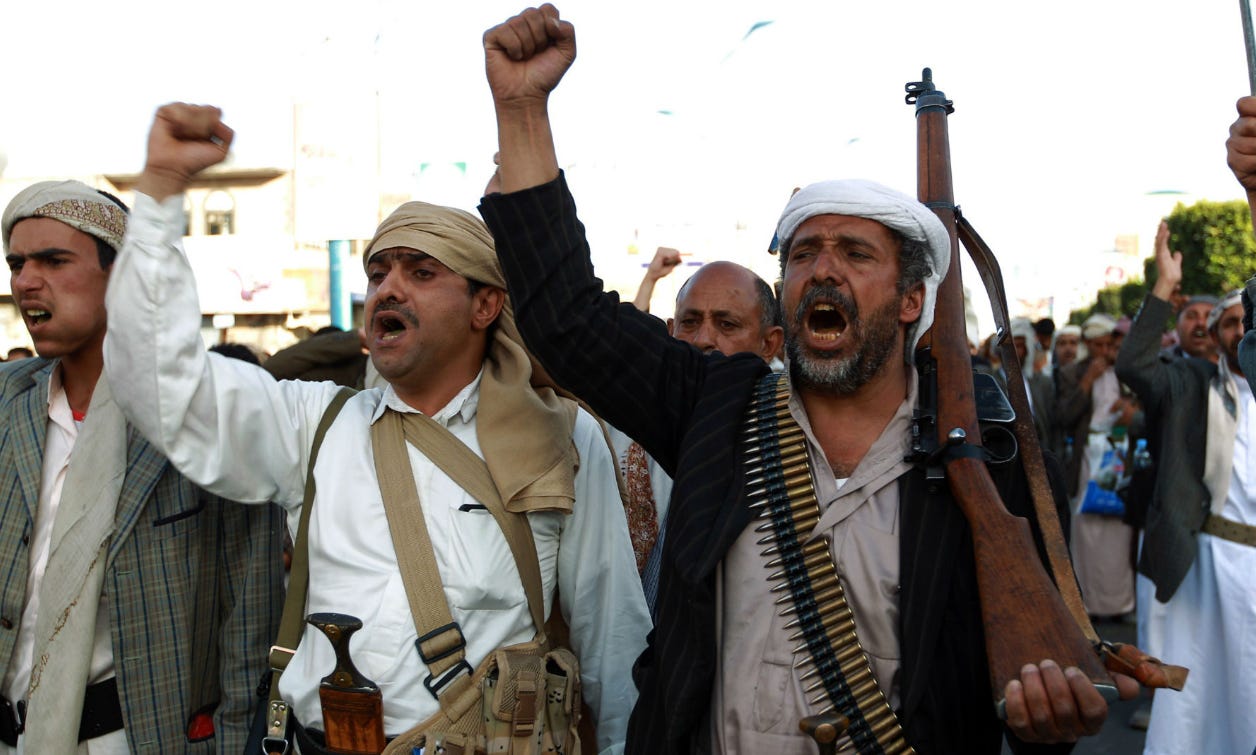
The Houthis are looking for a new enemy. The October 2025 Gaza ceasefire took away the cause that had carried them for two years, and the solidarity-with-Iran line they have tried in its place has gained little traction with a significant percentage of the population wary of Tehran. With the “defending Gaza” narrative minimized, the movement is reaching back for an older adversary — Saudi Arabia, which it fought from 2015 until the 2022 truce — and recasting it as the author of Yemen’s economic ruin. That search itself is a measure of the Houthis’ relative weakness: they are more fragile than they have been in years, underfunded, short of fuel and food, and losing their once-firm hold over some key northern tribes.
Their adversaries, namely the recognized Government of Yemen (GoY), are no stronger. GoY has, for once, made some headway — Saudi Arabia rolled back a UAE-backed offensive by the Southern Transitional Council (STC) in January, and a new GoY defense ministry has begun to weld its disparate forces into something closer to a single army. But the gains are shallow and growing shallower, undercut by the rivalry that jump-started the reforms. through local proxies, and the contest among them prevents GoY and what remains of the STC from consolidating. Saudi Arabia and the United Arab Emirates —with Israel backing Abu Dhabi, and Turkey and Qatar supporting Riyadh— pursue rival aims in Yemen.
While the Houthis have spent much of the last three years diversifying supply chains and sources of income away from Iran, the US-Israeli war with Iran has further reduced Iranian aid to the Houthis. Both the Houthis and the GoY are under pressure, and the outside powers that have, to varying degrees, propped them up are the main reason neither can finish off the other.
Searching for an Enemy
Behind the Houthis’ effort to look for an enemy lies increasing economic fragility. The World Food Program announced it was shutting down its operations across the Houthi-controlled north in late January, ending food assistance to a population in acute need. Fuel imports through the Red Sea ports of Hodeidah, Salif, and Ras Issa fell by roughly three-quarters in the first quarter of 2026, with no fuel entering at all in March. The United Nations estimates that more than 18 million Yemenis are facing acute food insecurity, while its humanitarian appeal for the year stood at around 14% funded by mid-2026.
Public-sector salaries across the north have gone unpaid for years, with only periodic payments for a small percentage of public-sector employees. Staple prices across Yemen keep increasing, with the increases most pronounced in Houthi-controlled areas, driven in part by reduced port capacity and the heavy taxes the Houthi authorities levy on what still gets in. The Houthis’ wartime slogans and messages of shared sacrifice ring hollow as members of the Houthi elite continue to construct lavish homes in Sana’a and elsewhere.
The Houthis are now trying to place the blame on Riyadh. They hold Saudi Arabia responsible for the unpaid salaries, so they demand that it release funds from Yemen’s oil and gas revenues and lift restrictions on the northern ports and Sanaa airport. Their media increasingly frames the wider economic crisis as a Saudi-American siege. In June, the movement’s General Mobilization Forces announced full combat readiness, and Abdul-Malik al-Houthi spoke of restoring “full sovereignty” and ending the blockade.
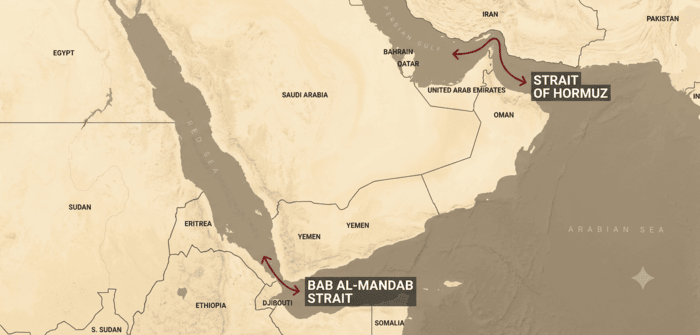
This is a return to a tested approach. The Houthis know from experience that their cross-border strikes on Saudi territory, including the 2022 strike on an Aramco oil depot in Jeddah, were what eventually brought Riyadh to the negotiating table. The threat to Saudi infrastructure remains their most reliable source of leverage. That leverage has only increased with the Iran war and the closure of the Strait of Hormuz. Saudi Arabia now relies on its East-West pipeline and the port of Yanbu for oil exports, both of which are within easy range of the Houthis’ missiles and drones.
Mobilization and the Tribes
The mobilization behind the Houthis’ anti-Saudi rhetoric is real, but narrower than the slogans imply. Recruitment continues under the movement’s wartime narratives, and fighters have been moved up to the front lines facing GoY and the Saudi border. Houthi authority over the northern tribes has always been more of a bargain than pure loyalty: money and government positions for cooperation, and a credible threat of punishment for anyone who withholds it. Both halves of that bargain are weakening at once — the money because the Houthis’ revenues have collapsed and the threat because two years of war have exposed the limits of what the movement can enforce. Sheiks in the outlying districts who once had no reason to question the arrangement are reassessing it, and with a Saudi-backed government reasserting itself in the south, the Houthis are no longer the only conceivable authority.
That reassessment is already producing friction. Tribal figures in several areas have resisted Houthi demands, and the movement has answered with purges, death sentences, and tighter surveillance of its own ranks. The leadership knows where this can lead. Ali Abdullah Saleh ruled Yemen through patronage as well, and lost it once corruption, falling revenue, and the cost of his wars left him unable to keep paying. The Houthis are nearer to that point now than they have been in years.
The strain is no longer hypothetical. In late June, a tribal call to arms filled the Al-Rayyan area of eastern Al-Jawf with armed men for days on end, drawing delegations from Hadhramaut, Marib, and the Mahra, after the Houthis detained a tribal sheik who had taken up the cause of a woman who said a Houthi-linked arms dealer had seized her Sanaa home. What began as a quarrel over a single house hardened into an organized encampment that named a commander to coordinate any escalation, while the Houthis put their forces in the area on alert. Confrontations like this are usually bought off or mediated before they reach gunfire, and this one likely will be. However, many tribal leaders who were once at least nominally allied with the Houthis sense the group’s weakness and are increasingly reasserting their local authority.
The Bab al-Mandeb
The same fragility that constrains the Houthis on land governs their conduct at sea. They hold much of Yemen’s Red Sea coast and have the anti-ship missiles, drones, and mines to make the Bab al-Mandeb impassable, yet they have left it open. Since the Gaza ceasefire, they have kept to selective strikes; in early June, they hit Israel-linked vessels in the Gulf of Aden and renewed a ban on Israeli shipping, but general traffic has kept moving, and the strait has not been closed. Traffic through the strait has yet to recover to pre-2025 levels.
The Houthis’ restraint reflects both weakness and pragmatism. The Houthis’ ports — Hodeidah, Salif, and Ras Issa — are critical to their finances and north Yemen’s economy. They tax all imports and depend on those imports to feed the north and fund the movement. A wider maritime campaign, or an outright closure, would bring the one response they cannot absorb as easily as they did in previous campaigns: renewed Israeli and American strikes on Hodeidah, which have already damaged port infrastructure and tightened the flow of food and fuel into Houthi territory.
For now, the threat of closure is far more useful than actual closure, and the threat of closing the strait has been replaced by the more potent and direct threat of attacking Saudi Arabia’s oil handling infrastructure. The Houthis’ dire financial situation and the rising threat of social unrest due to rising food prices and shortages mean that they need the strait open to maintain their grip on power.
Captured by Its Patrons
The Houthis’ core constraint is now financial. Yemen’s recognized government (GoY) faces a core constraint: its persistent inability to reform itself or govern the territory it claims. GoY, now more than ever, is dependent on its chief patron, Saudi Arabia, for financial and military support. Saudi Arabia’s increasingly overt management and backing of GoY are critical, but they also subvert GoY’s already limited authority. GoY’s one real gain of the past year, retaking the south, was Saudi Arabia’s work more than its own.
In December 2025, the Southern Transitional Council (STC), backed by the United Arab Emirates, launched “Operation Promising Future,” seizing the oil-rich governorates of Hadramawt and al-Mahra along the Saudi border. Though fought by Yemenis, the offensive was in substance an Emirati one, carried out with Emirati arms and Emirati backing. It came less than three months before the United States and Israel went to war with Iran, and within weeks of Israel’s December 26 recognition of Somaliland across the Gulf of Aden. Together, the offensive and the recognition are best read as an effort by the UAE and Israel to secure positions along the Red Sea and Gulf of Aden corridor before the confrontation with Iran began.
The effort failed. Riyadh treated a UAE-aligned force on its southern frontier as a direct threat, hit Emirati arms shipments at Mukalla on December 30, and backed a counteroffensive in January that retook the territory, dissolved the STC, and drove its leader, Aidarous al-Zubaidi, into exile in Abu Dhabi. The UAE withdrew its remaining forces. The episode nonetheless put Riyadh on notice. Saudi Arabia now treats the deepening UAE-Israel partnership as a driver of regional instability nearly on a par with Iran, and sees in it the makings of strategic encirclement along its flanks. Its answer has been to move closer to Turkey and Qatar while distancing itself from Emirati policy, and to take the southern file in hand itself, running it through a Supreme Military Committee under coalition command, a degree of direct control over Yemeni affairs the Saudis had avoided throughout the war.
Somaliland belongs to the same design. For Israel, recognition opened the way to a possible military and intelligence foothold in Somaliland, across the water from Yemen, from which to watch and strike the Houthis at a time when missile fire has all but closed the port of Eilat. A divided and contested Yemen serves that end, as does a southern authority open to the Abraham Accords, which the STC’s leadership had signaled it would join. For Riyadh, the UAE-backed offensive in south Yemen, paired with Israeli recognition of Somaliland, was an existential threat that required a maximal response.
The South
Whatever the maps now show, GoY’s hold on the south is shallow. The STC’s dissolution is disputed by members who reject it and continue to act in the group’s name, and the central demand of the southern movement, self-determination, is a direct threat to GoY and, now by extension, to Saudi Arabia and its regional allies. STC-aligned forces now operate as low-level insurgents against a government they were nominally part of until recently. GoY’s response has been forceful. Its troops fired on pro-STC demonstrators in Aden in February and in Mukalla in early April, killing several, and Human Rights Watch documented the use of excessive force and arbitrary detention in Aden. These actions undercut the already limited authority the government had only just begun to establish.
Yemen’s eastern governorates continue on their own particular trajectories. In Hadhramaut, the governorate that holds most of Yemen’s oil, the Saudi-backed Hadramawt Tribal Alliance (HTA) under Amr bin Habreesh continues to quietly press for autonomy and a larger share of the governorate’s oil revenue. The HTA answers to neither the government nor the southern separatists, and Saudi Arabia courts the alliance as a counterweight to both the GoY and the southern separatists.
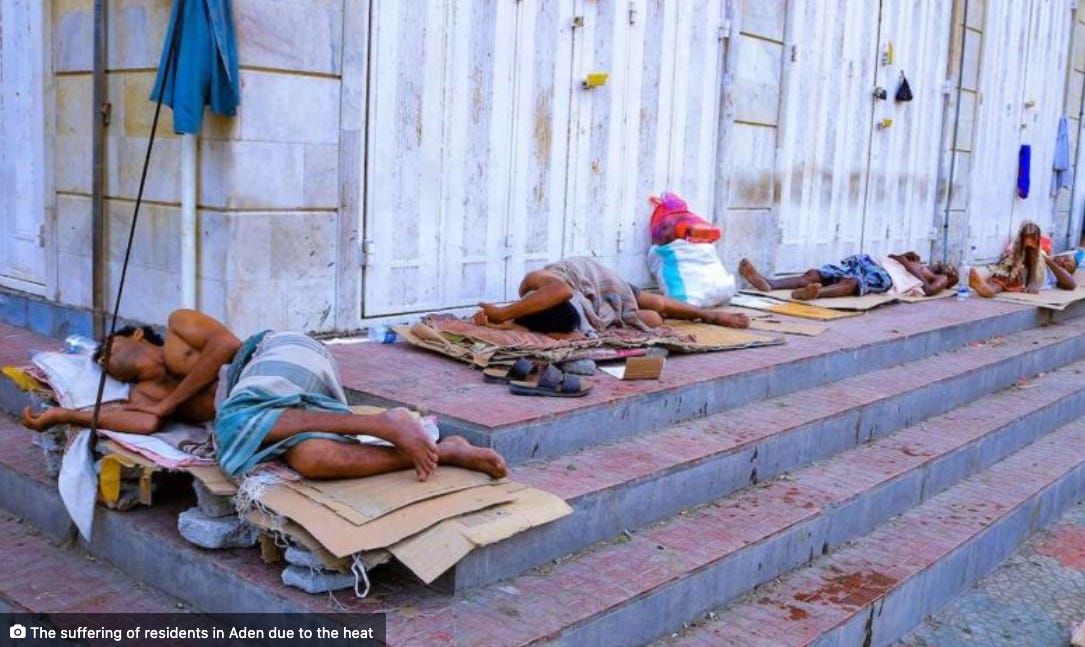
Image Source: Yemen Monitor
A Hollow State
The hollowness shows most plainly in GoY’s failure to keep the lights on in Yemen’s wartime capital, Aden. A Saudi fuel grant in January gave Aden close to twenty hours of power a day, an improvement residents had not seen in years. The relief did not last. As summer temperatures rose, outages lasted up to 20 hours a day, with residents protesting in the streets and some sleeping outdoors to escape the heat. A further $150 million Saudi fuel package announced in late May produced no noticeable improvement. Repeated promises followed by repeated shortfalls have become the pattern, and residents have stopped expecting otherwise.
Corruption remains a core driver of the ongoing failures. The electricity sector has long been among the government’s largest budget lines and one of its most plundered, with vast sums spent in recent years for little to show for it. The waste drains the treasury and, worse, leaves the government without the means to deliver the services on which GoY’s legitimacy rests. In most of what touches ordinary life for Yemenis — power, water, salaries, healthcare, the courts — it is a government in form more than in substance, recognized abroad and kept solvent by Saudi transfers.
The exception is the army, the one institution the government has genuinely begun to reform, albeit unevenly. Since February, a new defense minister has consolidated most of the duplicated commands and payrolls he inherited, begun a unified personnel database and biometric payroll to purge ghost soldiers from its rolls, and restored a measure of coordination among forces that had spent a decade pulling apart. Yet the strongest formations still answer to their own patrons and senior commanders rather than to a single chain of command — the Saudi-funded National Shield to the council’s chairman, the southern brigades to the commanders who raised them — and the central authority now drawing them together and funding them is the Saudi-led Supreme Military Committee, not the president of Yemen. Command and control is slowly being unified, but into Riyadh’s hands rather than GoY’s. Even the government’s one act of state-building deepens its dependence on its core patron.
Outlook: What Comes Next?
Neither the Houthis nor the GoY are positioned for or strong enough to launch the kinds of offensives that could reshape Yemen’s political and military landscapes. The front lines have scarcely moved since the 2022 truce and are unlikely to move over near- or medium-term timeframes. All armed parties in Yemen now possess a range of UAVs for surveillance and attack. The diffusion of UAVs further locks in the frontlines, as surveillance is ubiquitous and massing troops carries greater risks.
Due to what it perceives as an existential threat from the UAE and Israel, Saudi Arabia is now more deeply involved in day-to-day affairs in Yemen than it ever has been. Saudi military and civilian advisers are now key decision-makers who, in many cases, are positioned ahead of GoY civilian and military officials. Saudi involvement is unlikely to diminish in the near term, but neither is it likely to force GoY to move toward more durable and effective governance. At the same time, the Saudis, who are acutely vulnerable to a Houthi attack on the East-West pipeline, will continue to placate the Houthis despite their increasing anti-Saudi rhetoric.
The Houthis and GoY show increasing fragility across multiple sectors, which means they remain balanced against one another. This balance means that Yemen faces what it has faced for much of the last decade, a slow, grinding economic decline that punishes the vast majority of Yemen’s 36 million inhabitants while elites on all sides benefit. At the same time, the continued diffusion of increasingly capable military technology and armaments means that a range of armed actors operating across Yemen will be further empowered. This, in turn, further imperils GoY authority and, increasingly, Houthi authority.
About the Author:
Michael Horton is the co-founder of Red Sea Analytics International (RSAI) and a contributing author at Eurasia Outlook. He has two decades of experience as an analyst and researcher in Yemen and the Red Sea region. Michael has written policy briefs and conducted briefings and seminars for the US National Security Council, the British Foreign Ministry, the British Ministry of Defense, the US State Department, and senior members of the British Parliament and the US Congress. He has written extensively about the region for The Saratoga Foundation, Jane’s Intelligence Review, the Combating Terrorism Center at West Point, Oxford Analytica, and The Economist,.
Thank you for your support! Please remember that The Saratoga Foundation is a non-profit 501(c)(3) organization. Your donations are fully tax-deductible. If you seek to support The Saratoga Foundation, you can make a one-time donation by clicking on the PayPal link below! You can also subscribe to our website to support our work.
https://www.paypal.com/donate/?hosted_button_id=XFCZDX6YVTVKA