
by Vasif Huseynov
The South Caucasus is entering a new phase of regional energy reconfiguration as Azerbaijan moves forward with plans to transmit electricity to its Nakhchivan exclave through southern Armenia, along the Zangezur corridor.
What was once understood mainly as a transport initiative is now, under the Trump Route for International Peace and Prosperity (TRIPP), evolving into an energy corridor with significant regional and geopolitical consequences. The launch of construction on the Zangezur high-voltage transmission line and parallel political signals from Baku, Yerevan, and Ankara suggest that trans-regional energy connectivity may become the most immediate and transformative dimension of post-conflict normalization.
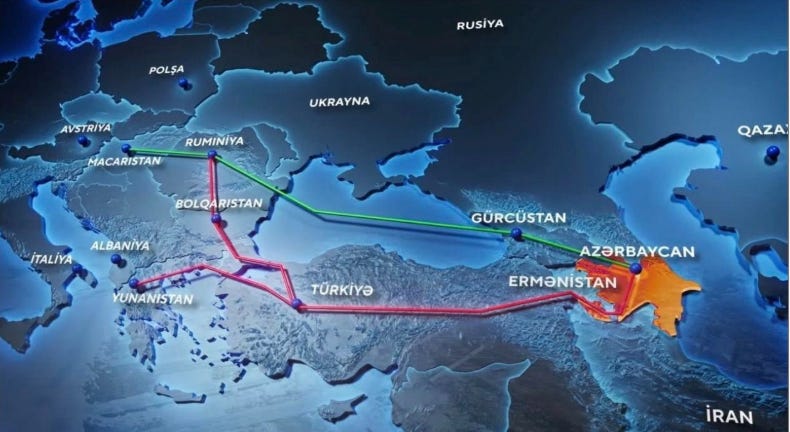
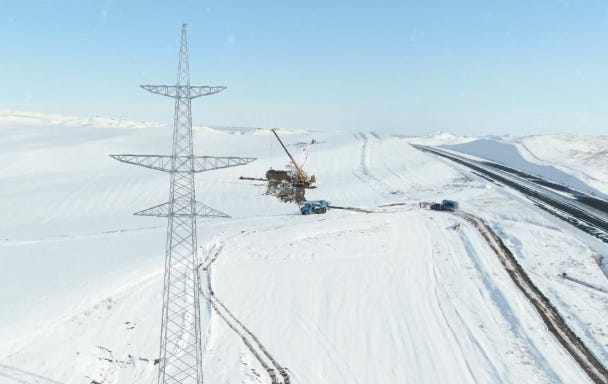
On January 29, it was reported that Azerbaijan had begun construction of the Zangezur high-voltage power transmission line, a technically complex project designed to integrate the Nakhchivan Autonomous Republic into the country’s unified electricity system and to form a critical segment of an emerging Azerbaijan–Türkiye–Europe electricity corridor. Implemented by AzerEnergy, the project centers on a two-circuit 330 kV transmission line with a total capacity of 1,000 megawatts. The first sections include a 74-kilometer line from Jabrayil to Aghbend and a 105-kilometer line from Nakhchivan to the Ordubad border, following the Araz River and crossing mountainous terrain that requires advanced engineering solutions. A subsequent phase envisages the construction of an additional 44-kilometer segment across the Zangezur corridor to connect Aghbend and Ordubad into a continuous internal transmission route, alongside a new 330 kV substation in Nakhchivan city.
Beyond eliminating Nakhchivan’s long-standing status as an energy island, the project enables centralized dispatch, access to reserve capacity, and more stable system operation. In parallel, Azerbaijan plans to build a 230-kilometer, 400 kV transmission line from Nakhchivan to Türkiye, including a 400 kV converter substation, which would align Azerbaijan’s grid more closely with European technical standards and significantly expand cross-border electricity transmission capacity. When completed, this will constitute an electricity line connecting the South Caucasus and Europe, and in the future, Central Asia and Europe via Azerbaijan and Armenia.
This internal integration is unfolding in parallel with a broader diplomatic and economic opening. In January 2026, Armenian Prime Minister Nikol Pashinyan confirmed that the energy systems of Armenia and Azerbaijan would be interconnected, allowing for mutual electricity imports and exports. He framed the initiative as one of the most practical early deliverables of TRIPP, arguing that a high-voltage transmission line could be built faster and at lower cost than rail infrastructure, while generating immediate economic returns.
According to Armenian experts, it would take around one year for Armenia’s electricity grid to be connected with that of Azerbaijan and Türkiye, although full integration of the energy systems would take several years. Armenian Prime Minister Pashinyan has confirmed that this had been discussed previously with President Ilham Aliyev and was reflected in the framework documents signed between Armenia and the United States earlier this month.
Reaction to these developments inside Armenia, however, has been mixed. While independent experts find this development critical for Armenia’s energy independence, opposition figures and pro-Russian expert circles portrayed the grid integration efforts as a threat to Armenian sovereignty, warning that Yerevan would be “handing the switch” of its energy system to Baku and Ankara. Such rhetoric reflects deeper anxieties about Armenia’s long-standing dependence on Russia, particularly in the electricity sector. Roughly 40 percent of Armenia’s power generation comes from the Metsamor Nuclear Power Plant, whose fuel supply and operation remain closely tied to Moscow. In addition, significant portions of the remaining infrastructure are controlled by Russian companies.
Yet Armenia’s energy dilemma is more paradoxical than these arguments suggest. The country produces roughly as much electricity as it consumes – around seven billion kilowatt-hours annually – and maintains substantial idle capacity that generates costs rather than revenue. Armenian officials have openly acknowledged that without regional interconnections, export potential remains largely theoretical. In this context, linking Armenia’s grid to Azerbaijan’s would provide it with access to synchronized systems in Georgia, Russia, and, via Georgia, Türkiye. For Yerevan, this would enable entry into a regional electricity market that cannot be reached independently, transforming surplus generation from a burden into a potential asset.
From Baku’s perspective, energy interconnection is a continuation of a long-standing strategy rather than a concession. Azerbaijan remains the only energy- exporting country in the South Caucasus, supplying oil, gas, and electricity to its neighbors while expanding its role as a supplier to Europe. President Aliyev recently emphasized that Azerbaijan exports natural gas to 16 countries, ten of them EU members, and ranks first globally in terms of the geographical reach of its pipeline gas exports. Electricity connectivity, particularly through Nakhchivan and the Zangezur corridor, adds a new layer to this profile by positioning Azerbaijan not only as a producer but also as a central transit and balancing hub.
Impact on the Zangezur Corridor
The Turkish dimension reinforces this shift. Ankara has repeatedly signaled that the Zangezur corridor will become a primary route for energy flows into Türkiye. Energy Minister Alparslan Bayraktar stated that while Azerbaijani electricity currently reaches Türkiye via Georgia, all energy resources (including oil, gas, electricity, and future green energy from Central Asia) are expected to transit through Zangezur in the near future. This would integrate logistical and energy routes, reducing dependence on single corridors and strengthening Türkiye’s role as a gateway between the Caspian region and European markets.
Such statements are not rhetorical flourishes but reflect concrete planning. Alongside hydrocarbons, Azerbaijan is investing heavily in renewable generation in its newly regained former western territories, including hydropower and large-scale wind projects. These projects are designed to feed into expanded transmission infrastructure, supporting export routes toward Türkiye and Europe, as well as the Black Sea Energy Corridor linking Azerbaijan, Georgia, Romania, and Hungary. Internal grid integration through Zangezur is thus a prerequisite for sustaining predictable cross-border electricity flows, especially as renewable capacity grows.
The geopolitical implications of these developments extend beyond energy economics. For Armenia, participation in a regional energy network represents a gradual reorientation away from exclusive dependence on Russia and toward a more diversified, market-based model. This helps explain the intensity of opposition from pro-Russian actors, who view interconnection with Azerbaijan as part of a broader erosion of Moscow’s leverage. Similar fears accompanied earlier Azerbaijani fuel supplies to Armenia, which were initially denounced as dangerous but were quickly accepted by consumers when lower prices disrupted existing monopolies.
Outlook
For Azerbaijan and Türkiye, the evolving energy landscape enhances their strategic depth and resilience. By developing multiple, interconnected routes for hydrocarbons and electricity, both countries are reducing their vulnerability to geopolitical disruptions while increasing their importance to European energy security. EU officials have already expressed interest in these new developments, pointing to routes via Nakhchivan and Georgia as strategic links connecting Central Asia to Europe and complementing the Southern Gas Corridor and emerging green energy initiatives.
That said, Azerbaijan’s Zangezur power line, Armenia’s willingness to interconnect grids, and Türkiye’s push to reroute energy flows signal a fundamental change in the region’s energy landscape. The South Caucasus is moving away from fragmented, dependency-driven systems toward a more integrated energy space shaped by market logic and strategic interdependence. Whether this transformation stabilizes the region in the long term will depend on political follow-through and regulatory coordination, but the direction is increasingly clear: energy is becoming the backbone of a new regional order.
About the Author
Dr. Vasif Huseynov is the head of the Western Studies department at the Center for Analysis of International Relations (AIR Center) in Baku, Azerbaijan. He is a faculty member at Khazar University in Baku. Dr. Huseynov had previously worked for the Center for Strategic Studies (SAM) and Public Administration Academy (DIA) in Baku. He holds a Bachelor of Arts degree in International Relations from the Academy of Public Administration in Azerbaijan, a Master of Arts degree in Global Political Economy from the University of Kassel in Germany, and a PhD in Political Science from the University of Göttingen, also in Germany. His MA and PhD studies were supported by full scholarships of German Academic Exchange Service (DAAD). He has authored several op-eds, articles, and academic publications, including a book titled “Geopolitical Rivalries in the ‘Common Neighborhood’: Russia’s Conflict with the West, Soft Power, and Neoclassical Realism”, which was published by Ibidem Press in 2019 and distributed by Columbia University.
Thank you for your support! Please remember that The Saratoga Foundation is a non-profit 501(c)(3) organization. Your donations are fully tax-deductible. If you seek to support The Saratoga Foundation, you can make a donation by clicking on the PayPal link below! Alternatively, you can also choose to subscribe on our website to support our work.
https://www.paypal.com/donate/?hosted_button_id=XFCZDX6YVTVKA
Thanks for reading! This post is public, so feel free to share it.