
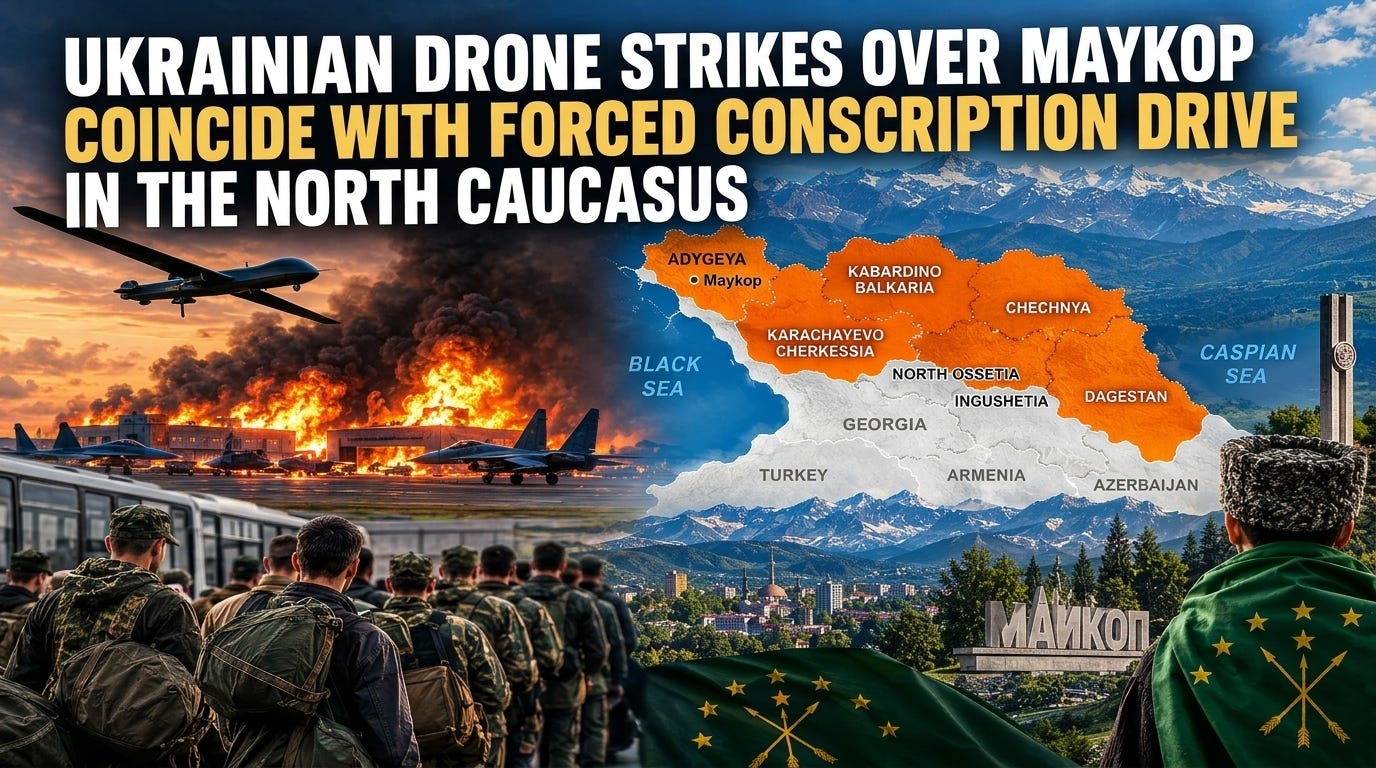
On the night of October 4, 2026, a large-scale Ukrainian drone strike targeted the Khanskaya military airfield, situated about 6 kilometers from the city of Maykop, the capital of the Republic of Adygea in the North Caucasus. Residents reported that the attack persisted throughout the night, prompting the activation of air raid sirens and causing multiple explosions and a large fire at the facility.
The Security Service of Ukraine (SBU) officially confirmed the attack, stating that their long-range drones successfully struck the airfield from a distance of roughly 500 kilometers (311 miles) from Ukrainian-controlled territory to the Khanskaya airfield. According to the SBU and subsequent satellite imagery analysis, the raid successfully hit and destroyed a Su-35 multirole fighter and a Su-34 fighter-bomber, along with an active ammunition depot on the base. The SBU emphasized the importance of destroying these specific aircraft because they serve as the primary carriers for Russian guided glide bombs, which Russian forces heavily rely upon in their frontline air strikes against Ukrainian cities.
The head of the Republic of Adygea, Murat Kumpilov, played down the gravity of the attack, stating that Russian air defenses intercepted and destroyed 28 Ukrainian drones in the Maykop area. He maintained that there were no casualties, noting only minor damage to the roofs and windows of several private homes. It is common for Russian officials to diminish the damage caused by Ukrainian attacks and exaggerate the number of destroyed Ukrainian drones. The Khanskaya airfield remains a vital strategic target for Ukraine. It also serves as a crucial refueling, training, and logistical hub hosting various Russian tactical aviation assets, including Su-30, Su-24, Su-34, and An-12 aircraft.
Rising North Caucasus Casualties in Russia’s Ukraine War
While the Khanskaya airfield has been attacked before, the October 2026 attack was apparently the most devastating to date in this westernmost Russian republic in the North Caucasus. Perhaps more importantly, the Ukrainian drone strike also stands to bring Moscow’s war in Ukraine back to the North Caucasus as Moscow continues an intense mobilization drive to recruit and conscript soldiers for its five-year-old war in Ukraine. The timing of the attack occurs as six residents of Kabardino-Balkaria (KBR) were recently killed while serving in Ukraine.
According to Caucasian Knot’s calculations, 483 servicemen from Kabardino-Balkaria alone have been killed in the Russian war against Ukraine as of mid-October. However, the joint project of Mediazona and BBC Russian Service puts the region's casualty count much higher at 862 as of October 7, 2026. Adygea alone has lost 652 people, while the North Caucasus republic of Karachay-Cherkessia has lost 541 people.
Circassian activists say that the Russian authorities forcibly mobilize Circassians to fight in Ukraine. At the time of partial mobilization in the Russian Federation in the fall of 2022, Circassian women staged protests, and some were even detained. Circassian human rights activists have repeatedly appealed to Russian authorities to cease mobilization in Kabardino-Balkaria. The largest protests in the North Caucasus at the time of the partial mobilization took place in Dagestan. The then head of Dagestan, Sergei Melikov, dismissed the protests as foreign-inspired events, as protesters blocked highways and clashed with the police.
Russia’s “Quiet Mobilization” Drive in the North Caucasus
Since the fall 2022 partial mobilization, Russian authorities have stopped large-scale and open mobilization efforts. However, activists claim that an undercover mobilization continues. Authorities in Kabardino-Balkaria have vehemently denied the accusations that a “quiet mobilization” is occurring in the republic.
Military Commissar of Kabardino-Balkaria Dmitry Pakhomov has tried to reassure its residents by stating that ongoing recruitment into the human mobilization resource reserve is a routine, strictly voluntary program rather than a covert mobilization. Pakhomov stated that reservists are tasked exclusively with protecting critical local infrastructure and countering drone threats in Kabardino-Balkaria, while retaining their civilian employment and receiving compensation equivalent to military contractors during specialized training.
At the same time, Pakhomov made several statements that highlight the exact type of “quiet mobilization” he had denied. The reservists are expected to voluntarily sign three- or five-year contracts, and the Military Commissar insisted that they cannot be dispatched to the war zone. Yet, he simultaneously confirmed that these contractors are legally equated to military personnel—a measure allegedly intended to ensure they can be held fully accountable while on duty.
Outlook
Conflicting assertions by Pakhomov contradict the well-documented track record of how Russia’s Ministry of Defense is managing localized military assets. The historical precedent of Russia’s Combat Army Reserve (BARS)—the precise reserve system Pakhomov is recruiting for—demonstrates exactly how these regional promises of army recruits serving locally function as a bureaucratic bait-and-switch operation designed to lure the locals into serving in the Russian army.
When BARS was initially created, volunteers were assured they would remain in their home regions to protect local infrastructure while keeping their civilian jobs; yet, immediately following the large-scale 2022 Russian re-invasion of Ukraine, these localized units were aggregated into volunteer battalions and deployed directly into heavy front-line combat in Ukraine. Similarly, localized Territorial Defense forces in the Belgorod and Kursk border regions were quickly subsumed into active combat roles once regional security degenerated, while Rosgvardiya—originally a domestic internal security force—was rapidly deployed to the front lines as conventional infantry.
Because Russia’s military leadership forced all irregular, regional, and volunteer formations to sign direct military contracts, it gained the absolute legal authority to override local agreements. For a volunteer in Kabardino-Balkaria, signing a multi-year contract that “equates them to military personnel” means entering a rigid chain of command. If Moscow shifts its directives—as it has done repeatedly throughout this conflict—any regional reservist who refuses a subsequent order to deploy to the front line would legally constitute insubordination or desertion under the strict provisions of the Russian Military Criminal Code, carrying severe prison sentences.
Ultimately, Pakhomov’s emphasis on legal military accountability reveals that this regional anti-drone reserve is less of a local defensive shield and more of a gateway structure designed to facilitate covert enlistment under the radar. This supports Circassian activists’ claims of quiet mobilization, indicating both the war's unpopularity and deep local distrust toward Russian authorities. Local anger has surged further following the forced mobilization and reported death of Syrian-Circassian repatriant Nurdin Qaraf in Nalchik. When his father publicly sought answers, Russian officials threatened him while state media attempted to spin Qaraf’s forced service as a patriotic duty—igniting fury both in the North Caucasus and throughout the overseas diaspora, where many sympathize with Ukrainian resistance against Russian rule.
Consequently, the October 4 Ukrainian drone attack on the Khanskaya airfield near Maykop comes at a pivotal moment of heightened tension across Adygea and the broader North Caucasus. By bringing the physical reality of the war directly to Maykop just as Moscow doubles down on forced conscription, the strike serves as a stark catalyst—linking the physical destruction of Russian strike aircraft on the ground to the growing regional backlash against the war's mounting human cost.
Thank you for your support! Please remember that The Saratoga Foundation is a non-profit 501(c)(3) organization. Your donations are fully tax-deductible. If you seek to support The Saratoga Foundation, you can make a one-time donation by clicking on the PayPal link below! You can also subscribe to our website to support our work.
https://www.paypal.com/donate/?hosted_button_id=XFCZDX6YVTVKA