
By Michael Horton
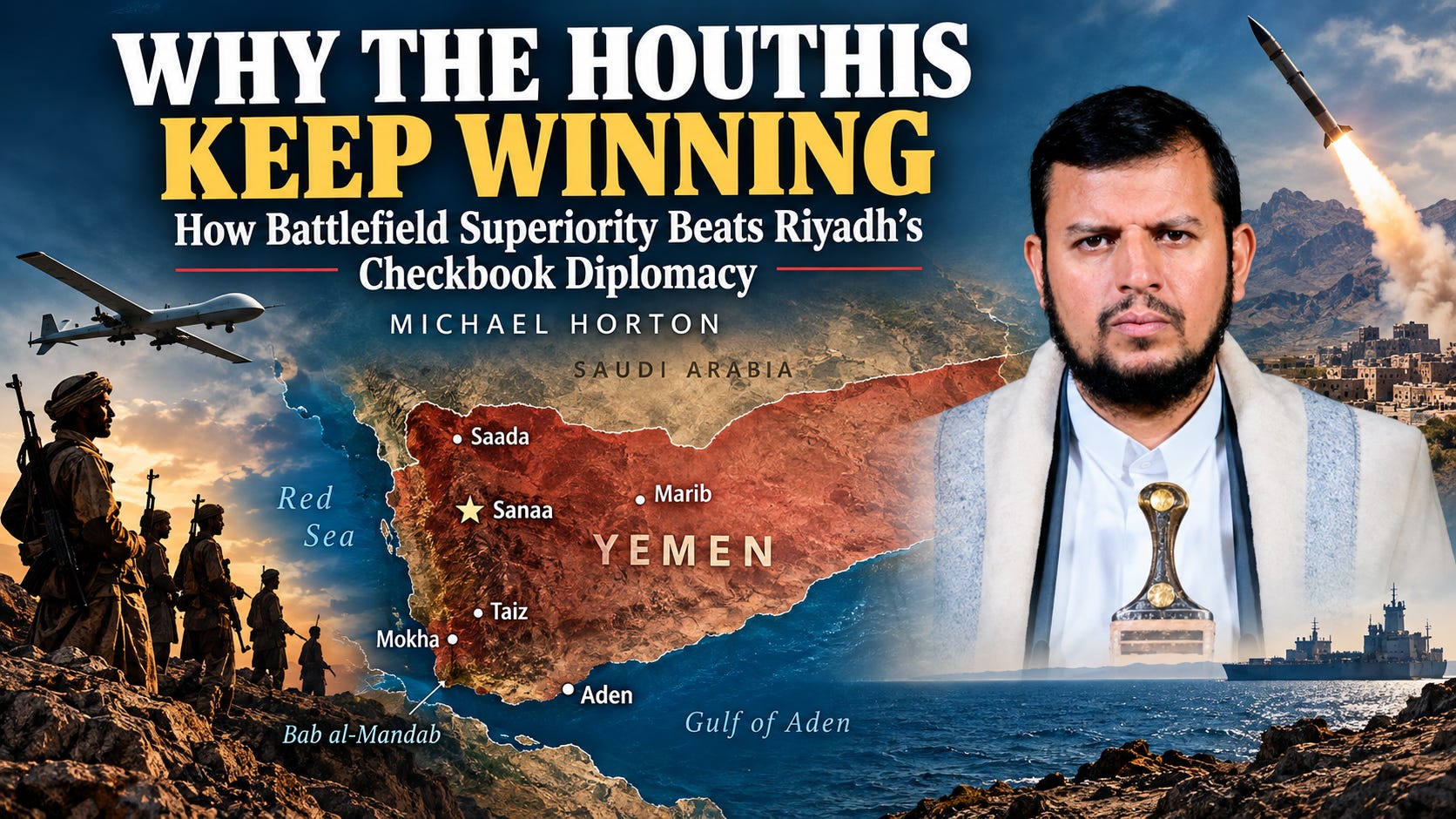
On October 26, Saudi Arabia’s defense minister, Prince Khalid bin Salman, who is also the younger full brother of Saudi Crown Prince Mohammed bin Salman (MBS), flew to Tehran with Pakistan’s Chief of Army Staff General Syed Asim Munir and Turkey’s Director of the National Intelligence Organization (MİT) İbrahim Kalın, whose countries joined the kingdom in signing the Mecca Defense Pact agreement in August. Riyadh called the trip an effort at de-escalation, but for all purposes the real aim of the trip was likely to ask Iran to rein in the Houthis. The prince reportedly brought an offer of $1 billion for the Houthis, to be routed through Iran, while Riyadh has not confirmed this report. Eleven days earlier, a senior Saudi diplomat had said that Iran was encouraging the Houthi attacks and that the kingdom had not asked Tehran to mediate.
That reversal reflects how the war is going for Riyadh. The Houthis are winning again, and for the same reasons they won the last war. The forces arrayed against them, nominally under the recognized Government of Yemen (GoY), are divided, lack a unified command of their own, and are hollowed out by corruption that Saudi money has made worse. By contrast, the Houthi command is unified, and its local commanders have the authority to make battlefield decisions as required. Drones and missiles have only amplified the Houthis’ advantage.
Meanwhile, the GoY’s offensive has stalled. Operation Dawn of Yemen, announced on October 4 with the stated aim of retaking Sanaa, lost momentum in its second week. GoY forces retook positions around Dhubab and the Bab al-Mandeb but never consolidated their hold around Mokha, an important port on Yemen’s southern Red Sea coast, which the Houthis seized on September 10 and still control. The Houthis also hold the high ground above the Tihama, a low-lying coastal plain that stretches from the Bab al Mandeb to the Saudi border. Control over it leaves any GoY advance up the coast exposed and in danger of being outflanked. In Marib, GoY claims a handful of hills near the Maas camp and north of Harib. The defensive lines there, however, have scarcely moved in recent weeks.
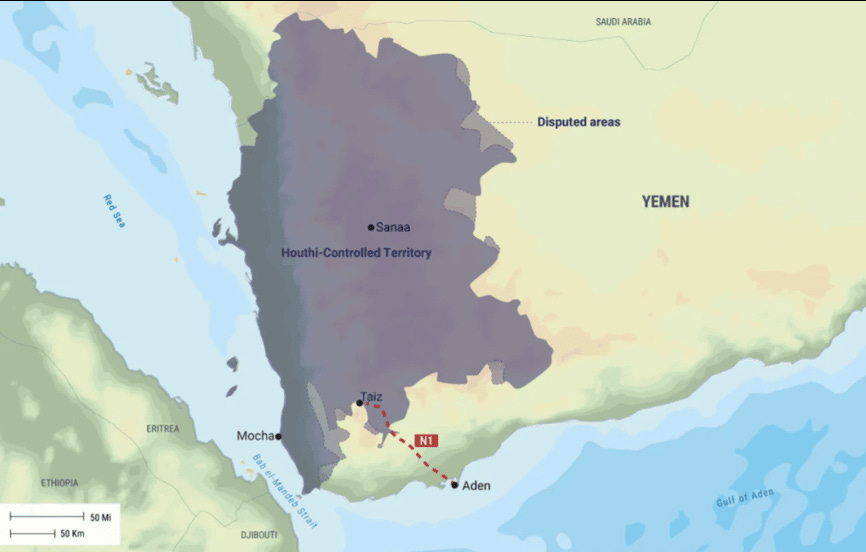
In recent weeks, the Houthis have tightened their grip on Taiz, Yemen’s third-largest city. On October 4, they took al-Turbah and cut the city’s main supply road to Aden. Al-Turbah is strategically important because it sits directly on the main highway connecting the city of Taiz with Aden (the interim seat of the internationally recognized Government of Yemen). Securing or severing this arterial road dictates whether forces in Taiz receive military reinforcements, humanitarian aid, and commercial goods. A week later, the Houthis had closed all four exits from the GoY-held city. More than 600,000 people in and around Taiz are now beyond the World Food Program’s reach. Prices for basic goods have doubled, and fuel prices have tripled. By encircling Taiz rather than storming it, the Houthis tie down GoY forces and Saudi aircraft at little cost to themselves.
Another Flood of Cash
Saudi Arabia is once again trying to buy its way through a war in Yemen. By 2020, five years into its first war there, it had spent an estimated $265 billion and had not won. Much of that money went to allies who never formed a single army. Islah-aligned forces which are broadly aligned with Yemen’s Islah party, held Marib. The separatists who held Aden took their money and their orders from Abu Dhabi, as did Tareq Saleh, who is the military commander of the National Resistance Force (NRF). Saleh is a member of Yemen’s Presidential Leadership Council (PLC), and nephew of the late former Yemeni President Ali Abdullah Saleh, and has built his own military force on the coast near Mocha. Their commanders answer first to their factions and their patrons.
Little has changed with this influx of Saudi money. When the coast fell in September, Tareq Saleh withdrew to Aden, where southern units at first refused to let his men enter the city. The Supreme Military Committee, set up in January to reorganize and command GoY forces, is run by the Saudi-led coalition, not by GoY. Progress has been made in centralizing command, but Riyadh, rather than GoY, holds ultimate authority. This slows decision-making and places much of the authority in the hands of Saudi officers who have little experience operating in Yemen and who do not understand the country’s complex tribal dynamics. In the field, the strongest formations still answer to the commanders who formed them and to the factions those commanders serve. Now, the Emiratis, whom Riyadh forced out of Yemen last winter, have agreed to resume paying some GoY forces in the south. Some southern commanders will now draw money from both Riyadh and Abu Dhabi, further complicating loyalties and already murky chains of command.
The money from Saudi Arabia has only worsened the corruption. After the Emiratis left, Riyadh took over the salaries of tens of thousands of fighters paid by Abu Dhabi. The defense minister introduced a biometric payroll to purge ghost soldiers from its payrolls. Still, some commanders have resisted, reportedly because it would expose how many soldiers on their rolls do not exist. In August, the defense minister ordered those salaries be paid directly into soldiers’ bank accounts rather than through their commanders. Some commanders threatened to pull their men off the front lines. One soldier said his last salary had been less than $40. Neither reform had cleaned up the rolls by September. When the Houthis attacked Mokha, some units there were close to 80% ghost soldiers.
Much of the money never reaches the units fighting in the frontlines. In Marib, for example, which is a key oil producing region of Yemen, officers talk about farmhouses outside the city where commanders keep millions of riyals and dollars in cash, out of reach of auditors. Others continue to add to their property portfolios in Cairo, Egypt.
Tribal Threats Backfire
GoY has also handed the Houthis a remarkable gift. Last week, the defense ministry warned that Houthi-organized tribal gatherings, which it said were being used to recruit children, would be treated as legitimate military targets. The post was later deleted. The government called it an “erroneous and unacceptable statement,” and the defense minister apologized, saying tribal gatherings would not be targeted. The retraction did little though to repair the damage. In the highlands, tribal gatherings are how the tribes mobilize and settle their disputes. The Houthis seized on the statement as proof that Riyadh and its clients regard the tribes as targets. Before the fighting resumed, many sheiks in the outlying districts were reassessing their bargain with the Houthis. The threat to bomb tribal gatherings, combined with civilian casualties and perceptions of a Saudi alignment with Israel, will likely push many to continue their uneasy alliance with the Houthis.
The episode reinforced a perception that is already widespread in Yemen: that GoY takes its orders from Riyadh and remains more a Saudi tool than a Yemeni government. Saudi Arabia sponsored the Presidential Leadership Council (PLC), which heads GoY, in 2022. Riyadh pays GoY’s soldiers, GoY’s offensive depends on Saudi aircraft, and its leaders spend long stretches of time in the Saudi capital. In contrast, the Houthis are deeply rooted in the socio-cultural matrix of Yemen’s northern highlands.
A Mosaic Command
The Houthi command does not share these weaknesses. Authority rests with Abdul-Malik al-Houthi and a small circle of advisers around him. Below that level, local commanders have wide latitude in choosing targets and timing. The structure was forged in the six Saada wars between 2004 and 2010, when the Houthis fought the Yemeni army in small units that had to act without orders from a leadership under constant threat. Iran calls its version mosaic defense. The Houthis practice their variant of this strategy daily on more than thirty fronts across contiguous territory, allowing them the flexibility to shift men and materiel from one front to another. In August 2025, Israeli strikes killed the Houthis’ prime minister, Ahmad Ghaleb al-Rahwi, much of his cabinet, and the movement’s military chief of staff, Maj. Gen. Muhammad Abd al-Karim al-Ghamari. Nevertheless, the movement’s conduct did not change.
Another factor helping the Houthis is their superior intelligence services. When they seized Sanaa in 2014, they absorbed the state’s intelligence agencies, decades of files on Yemen’s elite, and many of the officers who had run the state’s human networks. Their Security and Intelligence Service (SIS) has since penetrated much of GoY and most of its military commands. During the September attack on Mokha, the Houthis ran a major deception operation feeding false withdrawal orders into a coastal command that had no joint operations room linking its five formations. Among them was a recording, apparently made with an AI-cloned voice, in which the commander Tareq Saleh appeared to order his men to pull back.
Drones and missiles give the Houthis leverage over Riyadh. Saudi Arabia, roughly three times the size of Texas, offers a deep and rich target bank. In October alone, the Houthis struck or claimed strikes on airports in Riyadh, Dammam, Abha, and Najran and on Aramco facilities at Yanbu, Rabigh, Shaybah, and Dhahran. On October 8, a missile hit Riyadh’s airport, killing three people, among them a captain for Saudia national airlines, and burning out a parked Saudia airliner. Two days later, another strike on the airport killed thirteen. With Hormuz effectively closed, the kingdom depends on the East-West pipeline and the port of Yanbu for its oil exports. Flows through the pipeline were reportedly halted on October 5 after a strike on a pumping station.
Saudi air defenses are limited and spread thin. Built mostly to face the threat from Iran, their interceptor stocks were drawn down early in the Iran Gulf war. Earlier this year, the kingdom ordered 730 Patriot missiles for $9 billion, or more than $12 million a missile, and restocking can take up to 30 months. Every battery that is moved to defend Riyadh, royal palaces, and other vanity projects leaves Jizan, Abha, or Yanbu more exposed.
Few easy targets remain in Yemen. On October 13, Saudi aircraft struck the Yemen Oil Company’s al-Sabah station in Sanaa, which the coalition said was being used to store missiles and drones in underground fuel depots. The oil company said the tanks were empty. The Houthis are masters of physical and electronic camouflage, and many of their drone and missile production facilities are underground, in deep wadis, and under and within dense urban areas. On the ground, Riyadh is arming GoY-aligned forces with a wide range of drones, including first-person-view (FPV) drones, and these are inflicting losses on the Houthis. But the Houthis have FPV drones of their own and have been training with them far longer.
What Comes Next
The Houthis can continue striking Saudi Arabia for months. The war with Iran has already cut deeply into Saudi oil revenue, and the Houthi campaign compounds the damage. The IMF now expects the Saudi economy to contract by 3.3% this year; in July, it forecast 1.7% growth. The kingdom’s showcase for foreign investors, the Future Investment Initiative, has been canceled, and the United States has ordered non-emergency staff and their families to leave. The kingdom’s costs from damaged infrastructure, lost investor confidence, and curtailed exports could run into the tens, if not hundreds, of billions of dollars. No similar costs can be imposed on the Houthis. They rule what was the Arab world’s poorest country before the war began, and their leaders have lived under air attack, on and off, since 2004.
Yemen was a preview of what would happen in Iran, and both wars have exposed new limits on the ability of the United States to dictate the outcomes. In 2025, the United States launched Operation Rough Rider, which struck the Houthis more than 1,100 times in 52 days at a cost of over $1 billion. It also cost the U.S. seven MQ-9 Reaper drones shot down in its first six weeks, and ended in a ceasefire with the movement’s capabilities largely intact. The U.S.-Israeli war on Iran rested on the same assumption that enough firepower would force capitulation. Eight months on, the Iranian government is intact and is hosting the Saudi defense minister. Saudi Arabia should have learned the same lesson from its first war in Yemen. It did not, and it is failing again.
The weapons that exposed those limits are growing cheaper and more capable, and Artificial Intelligence (AI) is accelerating the process. For much of the past year, the Houthis have used AI to war-game scenarios, draft and test propaganda campaigns, and refine missile and drone designs. In September, Anthropic reported that a group in Houthi-held northern Yemen had used its Claude model to write guidance and control software for a guided rocket, a long-range ballistic missile, and a hypersonic glide vehicle. Anthropic found no evidence that the group had fielded an operational weapon, but the group carried out a failed test of a guided rocket and built a simulation toolkit that runs without Claude. The Houthis, like Tehran, will learn from this war and refine their strategies and procurement for the next round of confrontation. According to a report on October13, they are reportedly already seeking to build a more advanced medium-range ballistic missile with Chinese parts.
The Houthis are also building greater strategic depth across the Red Sea. They have deepened ties with al-Shabaab, whose fighters have reportedly trained in Houthi-held areas in drone operation and bomb making, and with factions in Sudan’s armed forces, whose personnel Houthi operatives have helped train on Iranian-designed drones. These groups are both clients and partners. They pay for Houthi weapons and expertise, and they help move materiel along smuggling routes in the Red Sea.
Lastly, Saudi Arabia has settled with its Yemeni enemies before. In 1970, it made peace with the republic it had fought for eight years. In 2023, it negotiated directly with the Houthis after seven years of bombing them. Now it is working through Tehran, which influences the Houthis but does not control them. In the end, Riyadh will likely buy the Houthis off and learn to live with them on its border, and the Houthis will come out of this war with more leverage than they had at its onset.
About the Author:
Michael Horton is the co-founder of Red Sea Analytics International (RSAI) and a contributing author at Eurasia Outlook. He has two decades of experience as an analyst and researcher in Yemen and the Red Sea region. Michael has written policy briefs and conducted briefings and seminars for the US National Security Council, the British Foreign Ministry, the British Ministry of Defense, the US State Department, and senior members of the British Parliament and the US Congress. He has written extensively about the region for The Saratoga Foundation, Jane’s Intelligence Review, the Combating Terrorism Center at West Point, Oxford Analytica, and The Economist.
Thank you for your support! Please remember that The Saratoga Foundation is a non-profit 501(c)(3) organization. Your donations are fully tax-deductible. If you seek to support The Saratoga Foundation, you can make a one-time donation by clicking on the PayPal link below! You can also subscribe to our website to support our work.
https://www.paypal.com/donate/?hosted_button_id=XFCZDX6YVTVKA